
BOONA
Bean and grain pasta for hospital and care kitchens
Dutch-grown beans milled together with heritage grain. 17g protein and 12g fibre per 100 g dry, in shapes your kitchen already cooks. Blast chill it, hold it, regenerate it on the ward, and it’s still pasta.

17g protein per 100 g
12g fibre per 100 g
Holds through cook-chill-regenerate
Dutch-grown beans
Contains lupin and wheat. Both are declarable allergens under EU 1169/2011, and lupin cross-reacts with peanut in some people. Full declaration below and on every pack.
The plant protein target lands differently on a patient tray.
The Green Deal Duurzame Zorg asks care providers to reach a 40/60 animal to plant protein ratio by 2030, with 50/50 as the point to be at in 2026. That target sits on catering for staff and visitors. For patients and clients the commitment is different, to do what’s medically responsible.
The distinction is there for a reason. Move a patient tray towards plants with what’s usually available and the protein on the plate goes down, on people who can least afford that. So patient catering waits, and the ratio shifts everywhere else first.
BOONA moves the ratio without costing protein on the plate. It won’t get an institution to 50/50 on its own, because that number is measured across everything served. It will move it, in a meal that’s already on the menu.
It works in the staff restaurant too, which is where the measurable target actually sits.


Pure bean flour gives you the number and takes away the pasta.
Legume pasta has good protein figures and a reputation problem. It softens in the pan, degrades on reheating and sits heavily. In hospital and care kitchens, that’s disqualifying, whatever the panel says.
So we blend, and every part of the blend has a job.
Heritage grain brings the gluten structure bean flour doesn’t have, and the ratio is calibrated per shape rather than the grain being there as filler. It brings flavour too, the nutty and mineral notes of spelt and emmer that pure bean flour can’t.
Beans bring the protein and the fibre. Fava, lupin and chickpea, grown in the Netherlands under the Bean Deal. The palette widens as more Dutch growers plant protein crops, and because the line changes between runs, the blend can follow what’s actually been harvested.
Psyllium husk binds a dough that would otherwise crack during extrusion and drying, and adds soluble fibre.
Grain and bean together also make a more complete amino acid profile than either alone. Grains are low in lysine and beans supply it. Beans are low in methionine and grains supply it.
Built for the way your kitchen actually runs.
Most hospital and care kitchens cook in bulk, blast chill to 0 to 3°C, hold, then regenerate at ward level in a trolley or an oven. Pasta isn’t designed for that journey and most of it reaches the bedside softer than it left.
Slow drying at low temperature is why BOONA holds. It keeps a stable bite through the full cook-chill-regenerate cycle.
If you run a different system, say so in the first call and we’ll tell you honestly whether it works.
Nutrition
Per 100g dry
Per 80 g portion
Energy
1399 kJ
331 kcal
1119 kJ
265 kcal
Protein
17g
13.6g
Carbohydrate
54g
43.2g
of which sugars
1.7g
1.4g
Fat
2.6g
2.1g
of which saturates
0.4g
0.3g
Fibre
12g
9.6g
Salt
0.03g
0.02g
Ingredients Mariagertoba wheat, Danish spelt, fava bean (16%), lupin (15%), psyllium husk fibre.
Allergens Contains cereals containing gluten (wheat, spelt) and lupin.
Cooked yield 2 x dry weight
Shelf life 3 years from production, ambient dry storage
Panel calculated
A note for dietitians. Fava beans can trigger favism in people with G6PD deficiency.

Shapes
Creste di gallo, casarecce, gnocchetti sardi, ditalini rigati and conchigliette rigati. All five are available now. All five hold sauce and all five portion cleanly, which matters more than it sounds when you’re plating five hundred.

No 145 · Meal + salad
Creste di gallo
Curved ridges with a ruffled edge hold sauce on two surfaces at once. It handles chunky and smooth sauces alike.

No 220 · Meal + salad
Casarecce
A twisted channel collects sauce inside and out. It’s forgiving in a tilt skillet or a large stockpot.
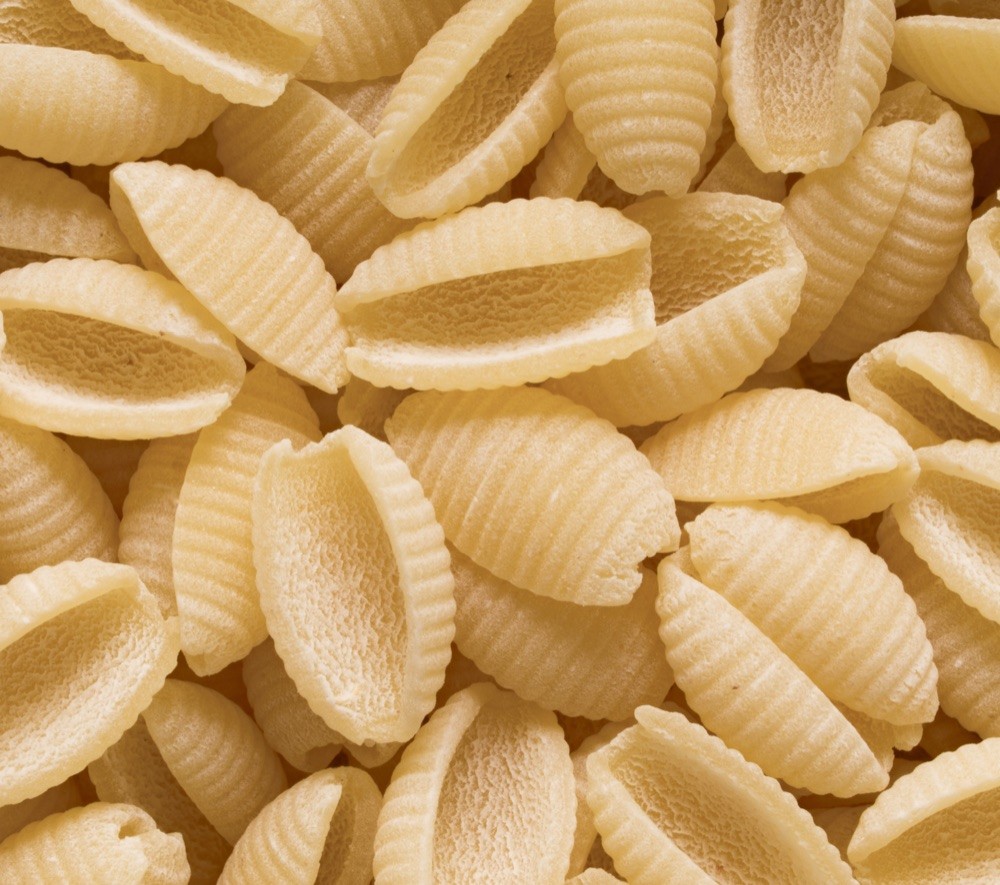
No 198 · Meal + salad
Gnocchetti sardi
Small ridged shells with a hollow underside carry their own share of sauce in every piece. Dense enough to keep its bite at volume, and built for chunky sauces and tray bakes.

No 345 · Soup + salad
Ditalini rigati
Short tubes built for soup. They cook quickly, hold their shape in broth, and sit on a spoon alongside vegetables and pulses without taking over the bowl.

No 188 · Soup + salad
Conchigliette rigati
Miniature ridged shells with a hollow centre trap broth and small vegetable pieces. Substantial enough for a chunky soup, small enough for a lighter one.
In the kitchen
Cook time
8 to 10 min from dry, rolling boil
Cook-chill-regenerate
Stable
Portion
80g, 50 per 4 kg bag
Storage
Cool, dry, away from sunlight
Pack sizes
8 kg case, 2 x 4 kg bags
Minimum order
400 kg
Lead time
4 weeks
Already on the ward.
Through Het Nieuwe Nassen at BlueCity Rotterdam, a ten week programme with nine care organisations funded by Gemeente Rotterdam and distributed by TotaalVERS, three plant-forward meals launched at St. Franciscus. One of them, a pasta bolognese, is made with ours.
We supply a number of Zuid-Holland hospitals and care facilities, at around 100 kg a week.
Certification
FSSC 22000 is in progress and we’ll tell you where it stands when you ask. Better you hear that now than after you’ve built us into a tender. HACCP and Non-GMO certification are already held.
Sample, trial, count, supply.

1. Send an enquiry.
Tell us your setting and roughly how many portions a day. We produce and send a sample, enough to cook and taste properly rather than a sachet.

2. Kitchen trial.
One to two weeks on your own line, your recipes, your staff. We’ll be on the phone for the first service if that helps.
3. Plate waste check.
Whatever measure you already run. If it doesn’t come back cleaner than what you’re serving now, we’d rather know than not.

4. Supply.
Minimum order 400 kg. Lead time 4 weeks. Ex works Rotterdam.
Cook it before you decide anything.
Tell us your setting and roughly how many portions a day, and we’ll send enough to run a proper service.


A Maker Station in Rotterdam, making pasta from regenerative harvests.
Contact
Maasboulevard 100
3063 NS Rotterdam
The Netherlands
© 2026 Gabanna FoodWorks, a brand of Green Banana Food B.V. · Privacy · Terms · Accessibility